· ReadyStack
Worked example
Real numbers from this tool, line by line.
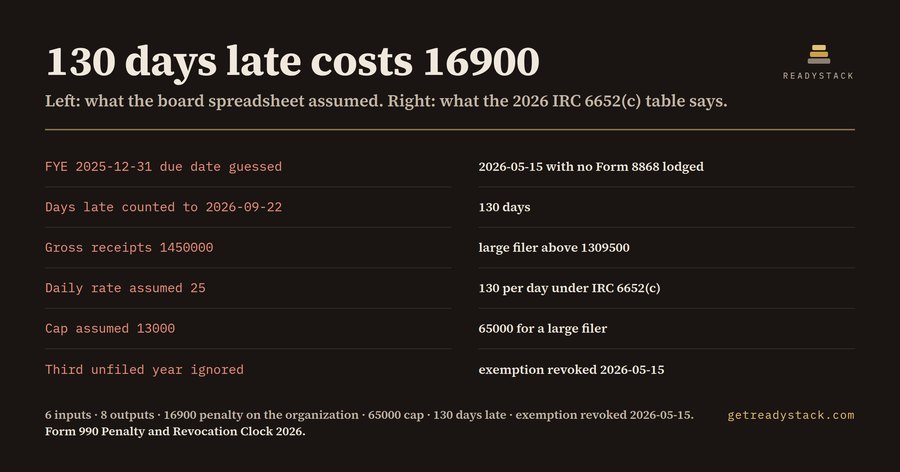
A US nonprofit that files its 2025 Form 990 on 2026-09-22 is 130 days late, and on gross receipts of 1450000 that is a 16900 penalty on the organization. That is the number a volunteer treasurer in Ohio, or a part-time bookkeeper running three small charities, needs before the board votes to approve a late filing.
The arithmetic is not hard, but three of its moving parts changed for 2026.
The due date. A Form 990 is due on the 15th day of the 5th month after the fiscal year ends. A 2025-12-31 year end is therefore due 2026-05-15. A Form 8868 filed on time buys six more months, moving that to 2026-11-15. It does nothing at all if the extension went in after the original due date.
The large-filer line. For returns required to be filed in 2026, an organization is a large filer if gross receipts exceed 1309500. It is inflation-adjusted every year and is the figure most often quoted wrong. For returns required to be filed in 2027 it becomes 1339500.
The daily rate and the cap. Below the large-filer line the penalty is 25 per day, capped at the lesser of 13000 or five percent of gross receipts for the year. Above it the penalty is 130 per day, capped at 65000 for that one return. The statute itself, IRC 6652(c)(1)(A), still reads 20 per day, which is exactly why older summaries and general-purpose chat answers hand back a figure that has not been correct for years.
Run the two cases side by side and the spread is obvious. An organization with 300000 in receipts that lodged Form 8868 on time and files on 2026-12-20 is 35 days past its extended 2026-11-15 date: 25 per day, so 875. An organization with 1450000 in receipts and no extension, filing on 2026-09-22, is 130 days past 2026-05-15: 130 per day, so 16900.
There is a second penalty that boards forget. Under IRC 6652(c)(1)(B), once the IRS issues a written demand to a named officer or director and the return is still not filed, that person owes 10 per day personally, capped at 6500 per return. A June year-end organization with a written demand outstanding, filing on 2027-03-01 against a 2026-11-15 due date, is 106 days late: 13780 on the organization and 1060 on the officer who signed nothing.
And the part that is not a penalty at all. Under IRC 6033(j), three consecutive years without a required return revokes exempt status automatically, effective the due date of that third return. No letter has to arrive first. An organization that has already missed two years and is late on the third is looking at a revocation date of 2026-05-15, and retroactive reinstatement means filing an exemption application with its user fee within 15 months of the later of the revocation letter or the IRS auto-revocation list posting.
The clock does this in the browser. Enter the fiscal year end, gross receipts, the date you expect to file, whether the extension went in on time, how many earlier years were never filed, and whether a written demand has arrived. It returns eight numbers: original due date, extended due date, days late, the 2026 daily rate, the cap, the penalty on the organization, the penalty on the officer, and the revocation date. Nothing leaves the machine.
All of that is free, unlimited, with no watermark and no lockout. The paid key sits on a different axis: it exports every organization you have checked to a CSV that goes into the board file, and it sets browser alarms 60 and 14 days ahead of each due date you saved. A CPA-prepared Form 990 is quoted at 500 to 2,500 dollars per return in 2026 pricing guides, and a delinquent cleanup sits above that.
15 seconds — what it actually does
Full walk-through
Questions people ask
What does this actually work out for me?
You enter six things: fiscal year end, gross receipts, the date you expect to file, whether Form 8868 went in on time, how many earlier years were never filed, and whether the IRS issued a written demand. It returns eight figures: original due date, extended due date, days late, the 2026 daily rate, the cap, the penalty on the organization, the penalty on a named officer, and the revocation date.
Who is this built for?
Volunteer treasurers, part-time bookkeepers and executive directors at US 501(c)(3) organizations who file Form 990 or 990-EZ and have just realised a deadline slipped. It is also used by board members who want the exposure number in the minutes before they vote to approve a late filing.
Why is a free chatbot not enough here?
The IRC 6652(c) amounts are inflation-adjusted every year, so answers trained on older material still quote a 20 per day rate and the wrong large-filer line. For returns filed in 2026 the threshold is 1309500 in gross receipts, the rates are 25 and 130 per day, and the large-filer cap is 65000.
What is free and what needs the key?
Every calculation is free, unlimited, with no watermark and no lockout. The 60 dollar key adds two things on a different axis: a CSV export of every organization you have checked, so the numbers can go into a board file, and browser alarms that fire 60 and 14 days before each due date you saved.
What would this cost me otherwise?
A CPA-prepared Form 990 is quoted at 500 to 2,500 dollars per return in 2026 pricing guides, and a delinquent-filing cleanup sits above that because the preparer must rebuild several years. The exposure itself is capped at 65000 for a large filer, or the lesser of 13000 and five percent of receipts otherwise.
Ask about this tool
One question, answered by the person who built it. Your email only if you want the answer sent.